First steps into competitive programming: DTU teams gained valuable experience in Germany
Two DTU teams joined Northwestern Europe Regional Contest (NWERC) 2025, solving tough problems and returning home with insights and motivation for next year – while Denmark celebrated gold and bronze.
In total, 11 Danish teams competed in Karlsruhe representing Technical University of Denmark, Aalborg University, Aarhus University, IT University of Copenhagen, University of Copenhagen, and University of Southern Denmark.
Monday 15 December 2025
Hanne Kokkegård
At the end of November, two DTU teams took part in the Northwestern Europe Regional Contest (NWERC) 2025 in Karlsruhe, a prestigious programming competition. The event gathered hundreds of talented students from across the region, all racing against the clock to solve 12 challenging algorithmic problems within five hours.
For the DTU students, this was their debut. The teams solved five and four problems respectively – a strong performance given that none of the students had ever competed at this level before.
“It didn’t earn them a top spot, but I’m extremely proud of their achievements. It’s impressive when you think about the fact that they had never tried anything like this before,” said Inge Li Gørtz, Professor at DTU Compute and Coach for the teams.
“Everyone came home happy and eager for more. Several of the students are only halfway through their bachelor’s degree, so this is a great starting point for the coming years. This year was all about learning how it works.”
“An absolute rush!”
Pedro Diniz, a third-semester General Engineering student specialising in Cyber Systems, described the experience as unforgettable:
“Taking part in NWERC 2025 was a surreal experience. The atmosphere was incredible; we met so many brilliant people and interacted with world-leading companies to understand their real-world challenges.”
“The contest was an absolute rush! It was challenging, intense, and most importantly fun. There is a special energy when you're cracking tough problems in a hall with hundreds of other programmers as the clock ticks down. That is exactly what we want to bring back home by setting up and participating in training groups and workshops,” he said.
Two Danish medals
While DTU didn’t take home medals this time, Denmark had plenty to celebrate.
Out of 11 Danish teams from six universities, Aarhus University claimed gold by solving 11 problems and finishing third overall, while the University of Copenhagen earned bronze with 10 problems solved and a ninth-place finish.
Both teams now advance to the European contest.
“Two Danish medals! That’s truly impressive and not something we usually see. Congratulations to Aarhus and Copenhagen,” said Inge Li Gørtz.
Looking ahead, the Danish universities are planning joint training camps and activities over the next year to strengthen collaboration and inspire more students to join the world of competitive programming.
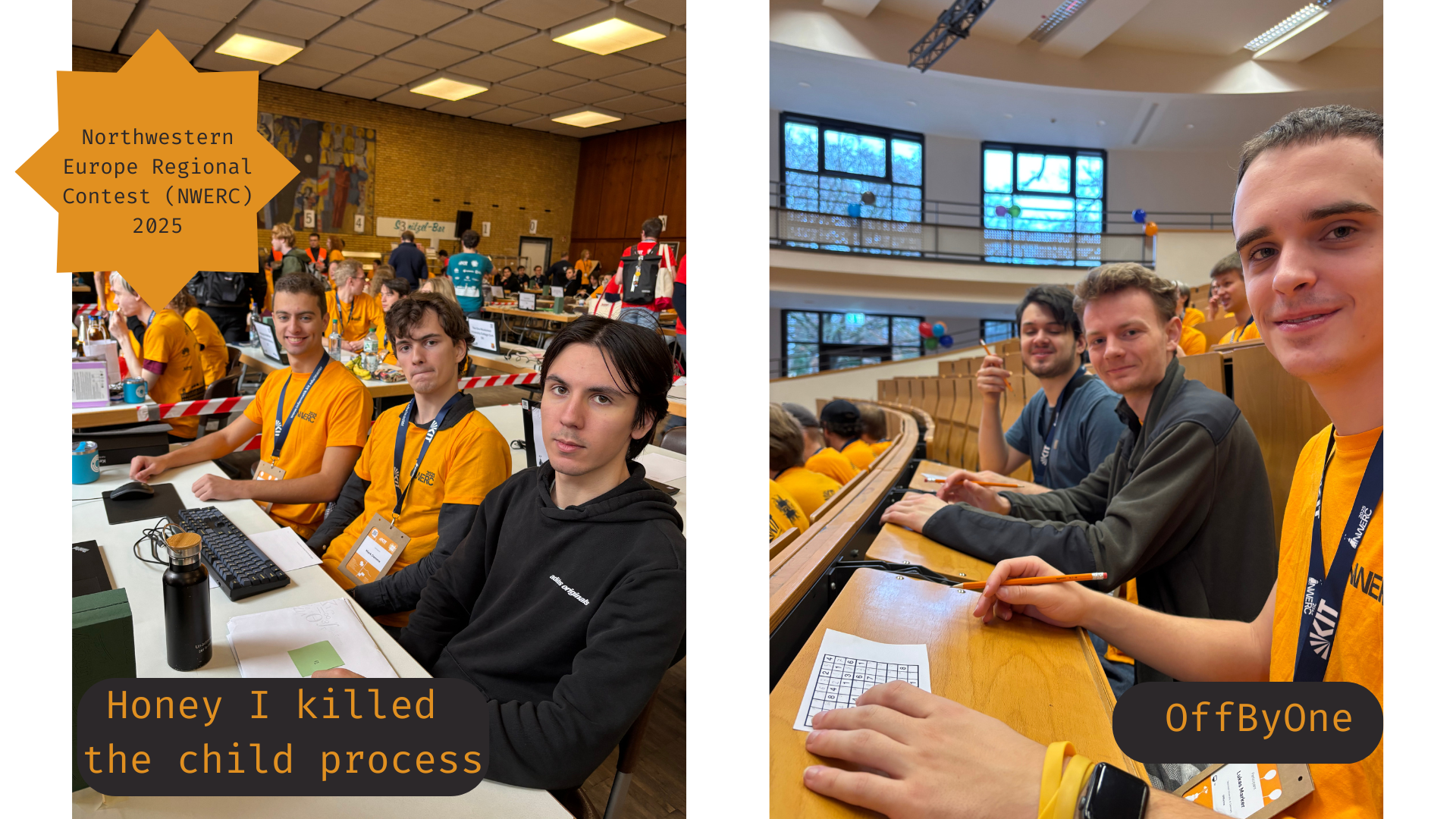
The two DTU Compute teams the day before the competition in Karlsruhe, Germany. Photo: Inge Li Gørtz
Facts about the two DTU teams
OffByOne
Martin Keith Buchreitz
Lukas Marker
Jonathan Sommerlund
Honey I killed the child process
Pedro Diniz
Mark Damme
Emil Andranik Overbeck
In total, 11 Danish teams competed in Karlsruhe, representing
Technical University of Denmark | DTU Compute
Aalborg University, AAU
Aarhus University, AU
IT University of Copenhagen, ITU
University of Copenhagen, KU
University of Southern Denmark, SDU
Facts
About the contest
The Northwestern Europe Regional Contest (NWERC) is a contest in which teams of three students from universities all over northwestern Europe tackle a series of algorithmic problems. The goal of each team is to solve as many problems as possible within the 5-hour time limit. Teams submit their potential solutions to a judging system where they are automatically evaluated.
The problem set consists of a number of problems (usually 12) and will be provided in English at the beginning of the contest. For each problem, teams are required to write a program in C, C++, Java, Python, or Kotlin that reads from standard input (stdin) and writes to standard output (stdout), unless otherwise stated.
The team that solves the most problems correctly wins. If two teams solve the same number of problems, the one with the lowest total time is ranked higher. The total time is calculated as the sum of the time taken for each solved problem, with a 20-minute penalty added for each incorrect submission.