Denmark needs a national long-term strategy for chip design
In Denmark, there is an ongoing discussion about how the country can contribute to the future of chip production in Europe. At Digital Tech Summit, universities and industry discussed the issue and received some advice from Meta: Go for the white space instead of the red ocean. The discussion highlighted the need for a vision to better steer the direction of the work.
Monday 04 November 2024
Hanne Kokkegård
If Denmark wants to be a significant player in the European chip agenda, we must focus on our strengths and particularly pursue them, such as edge AI. Although the EU Chips Act will channel money to the member states, it will be far from enough to truly establish an ecosystem for developing and producing microchips in the race with the USA and Asia.
This was one of the conclusions when the Nordic region’s largest deep-tech fair and conference, Digital Tech Summit, in Øksnehallen in Copenhagen, which featured a panel debate between representatives from Meta, NVIDIA, the hearing aid manufacturer WSA, Aarhus University, and DTU Compute with Head of Department Jan Madsen and Moderator Jørgen Kragh Jakobsen, who is an analogue circuit designer and owner of the one-man company IC Works.
Since advanced microchips are a crucial prerequisite for digitalization, ensuring fast and efficient data processing, it is natural that the EU Chips Act is a significant topic when more than 4,500 people from universities and industry gather for a conference in one of the world’s most digitalized countries.
The EU’s vulnerability was revealed - we are too dependent
Ahead of the debate, Minister of Industry, Business and Financial Affairs in Denmark, Morten Bødskov gave a keynote speech, where he pointed out the rapid change and views on chip design in few years from everything is great to a global race in defining and developing new technologies.
“Before the COVID-19 pandemic, I guess it's fair to say also that we did not worry that much about these, so to say, tiny plates of silicon. But it has changed since then. Everybody is focused on producing and developing chips now. Suddenly, it became very clear that most of our advanced microchips came from just one place, Taiwan. And that setup is simply too risky. We need more and we need more different suppliers of chips to make sure that we are able to address the critical needs that we have and the critical materials that we need. Otherwise, we cannot innovate, we cannot compete, and we will simply fall behind. We will lose jobs, we will lose investments, we will lose money, and we will lose possibilities to develop the good side of our society. Because the world today has not become more stable or more reliable. We did not return back, after the pandemic to the good old time, to the secure and stable supply chains that we saw before the COVID pandemic. Today, we are looking into geopolitical tensions, and they will define the times that we're living in now,” Morten Bødskov said.
The risk of dependency called for a joint response from the European Union nearly three years ago with the European Chips act. China and the US had already invested fully in the microchip agenda. The new European Commission has made it a priority to follow up on the European chips act and they proposed a European chips plan. But how can Denmark contribute to that agenda? Well, the German government has for example set aside five billion euros in public funding for only one (chip factory, editor) factory.
“There's no doubt that we cannot follow that track when it's only about public money. We have to find ways where we actually can make a difference as we have done so many times before in our history,” the minister said.
Scepticism about the EU Chips Act - not ambitious enough
It aligned with the message in the debate after, when Michael Smedegaard, a Danish national who's had his entire career in the USA, now as Chief Audio HW Architect at Meta, mentioned that the EU have allocated 43 billion euros to the chips act, but it is far too little money. Which is one of the major points of criticism that he had heard about the EU Chips Act.
The goals are viewed as too modest compared with investments made in the USA and Asia. Insufficient funding as part of the same coin, allocated budget can be seen as too small to make a significant impact on EU's semiconductor industry. How EU spend the money is really important, and a discussion at national level in the EU is necessary to figure out how to strengths of the ecosystem in each specific country in the EU, he said.
Another element of criticism is that the EU Chips Act prioritizes research over production, neglecting the need for large-scale investments. This will delay the work.
The Chips Act doesn't address the brain drain of engineers leaving for the US.
The final point of criticism is that it's got a slow timeline where both the implementation and also the funding is seen as too slow to keep up with the rapid pace of the development in the semiconductor industry. The EU is up against the free market forces of private companies or mostly private, part public companies like TSMC.
Go for the white space – how about Edge AI?
“I think we need to take a hard look at our core competencies across the spectrum of the entire tech sector and identify areas that contain more white space than the red ocean. When we talk about AI and chips, everybody is thinking about NVIDIA at the moment. And that's a runaway success story. Can you repeat that? Probably not if you try. But if you invest in all the areas where Denmark has potential, it's a good likelihood that a new NVIDIA, if you measure it as a success, will emerge from that ecosystem. So, I think a public debate about how we do this, how we allocate the funds, what our core competencies are, is needed,” Michael Smedegaard said and pointed out one area, where Denmark could play a great role: Edge AI.
Edge AI/computing involves running smaller artificial intelligence models directly on devices rather than relying on cloud-based solutions. While large language models (LLMs) like Meta’s Llama or OpenAI’s ChatGPT have 70-80 billion parameters, there are also smaller models with fewer than 10 billion parameters. These smaller models can operate locally on devices using application-specific semiconductors/chips, which is a niche but growing area. This approach reduces the need for constant cloud connectivity and can enhance performance and privacy.
“And let's also not forget that most of the successful semiconductor companies are fabless. You don't need a fab to become a semiconductor company. Apple doesn't have a fab. NVIDIA doesn't have a fab. Broadcom, AMD, etc. So, the notion of what you need and what you need to invest and where you get the maximum output from your investments, that's a very detailed debate that I think that we must have, Michael Smedegaard said.
Keynote and debate at Digital Tech Summit: Tokenism or national endeavor: Keynote by Minister of Industry, Business and Financial Affairs in Denmark, Morten Bødskov, Socialdemokratiet. Panel: Head of Department at DTU Compute, Professor Jan Madsen. Farshad Moradi – Professor, Aarhus University. Henning Lysdal - VP Photonics Architecture, NVIDIA. Ketil Julsgaard - Global Head of IC Development, WSA. Michael Smedegaard - Chief Audio HW Architect, Meta. Moderator: Jørgen Kragh Jakobsen - IC Works. Photo: Hanne Kokkegaard, DTU Compute
Minister of Industry, Business and Financial Affairs in Denmark, Morten Bødskov gave a keynote speech at Digital Tech Summit. Photo: Mikal Schlosser
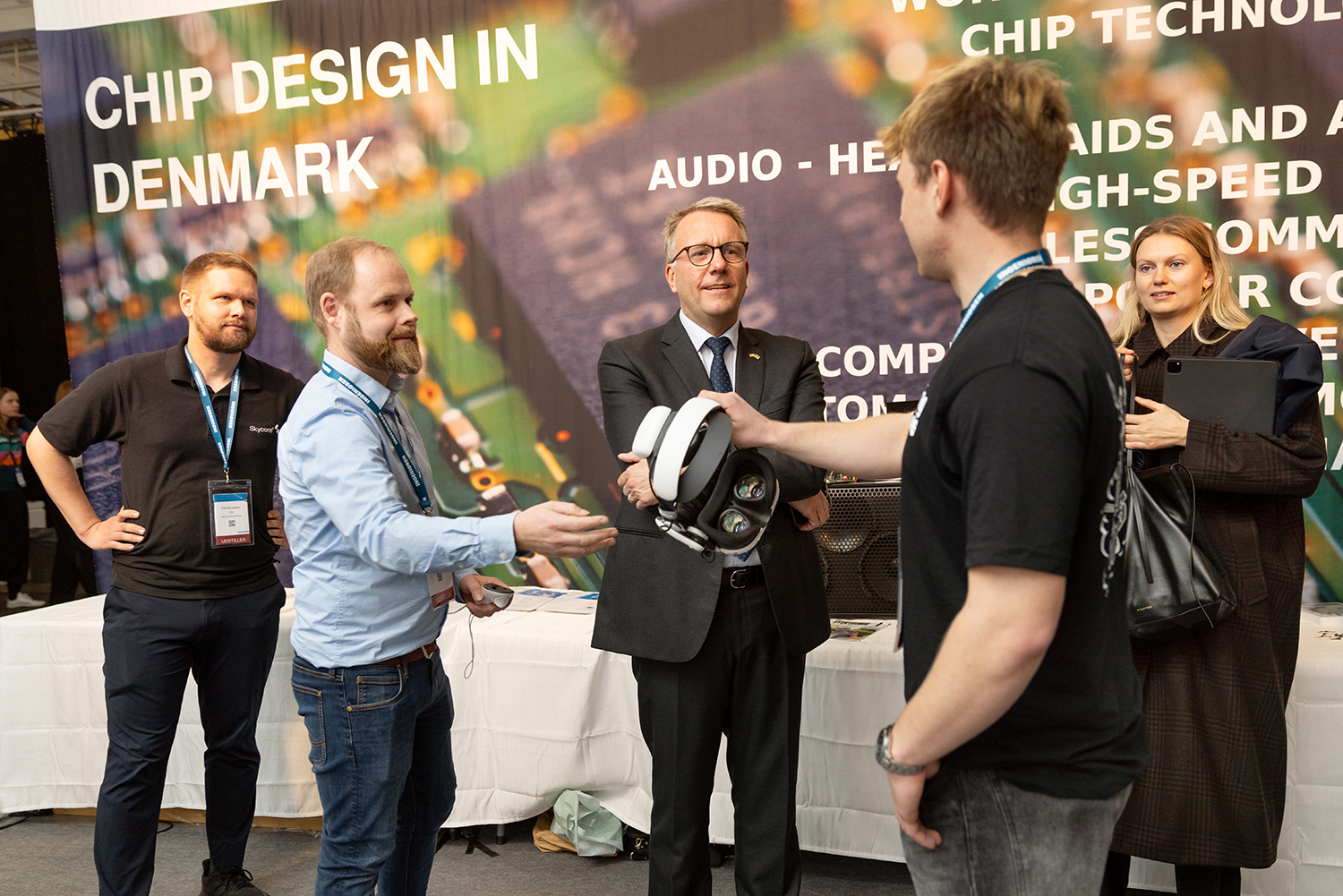
Minister of Industry, Business and Financial Affairs in Denmark, Morten Bødskov also visited the booth for the Danish Chip Design environment at Digital Tech Summit. Photo: Mikal Schlosser
DTU Compute: We need a long-term strategy
Smedegaard’s proposal to focus on Edge AI aligns perfectly with DTU Compute’s research, explained Head of Department at DTU Compute Jan Madsen after the debate. (See the fact box)
Computing happens in a continuum from the cloud over mobile and Edge devices to the tiny sensor and actuator devices as part of the IoT. Hence, AI is not only the large LLMs executing in the big data centres, but also much smaller AI’s running on the Edge and even in small sensor devices, called Embedded AI.
"Today there is a huge focus on cloud services, such as the new AI supercomputer Gefion from NVIDIA. Denmark has a long tradition of producing specialized high-quality products, such as advanced hearing aid devices, and many small IoT devices for industrial automation, agriculture, healthcare, etc., will benefit from small, advanced chips combining analogue and digital chip design, including tiny AI architectures,” Jan Madsen said.
He also commented on the criticism of the EU Chips Act that is focuses too much on research. It shows that people see it from different perspectives.
"A Danish chip competence centre is being created with a four-year horizon (see more below). That’s fine, but Denmark needs a national long-term strategy that extends much further. If we want education and talent, we also need to research it. Research is a crucial part of the ecosystem. It is important both to attract young students and to attract foreign talents. We also see that
PhD students are supported by foundations, so there is a shared interest in this field,” said Jan Madsen.
The Head of Department also highlights that there is full enrolment in the new bachelor’s program at DTU “Computer Engineering”, which covers both chip design and broader computer design - for large to small devices. The admission quota was quite high to get into the program, indicating demand. This is backed up by the fact that each spring 130 students attend DTU Chip Day to meet around 20 companies within the chip design industry.
He agreed with Henning Lysdal, VP Photonics Architecture at NVIDIA that in the debate said, that money is distributed in too small units, so everyone gets a little instead of being more strategic.
"The government is looking a lot into quantum computing, which is also very hyped. We are still in the early stages of the technology. It is super important and can be a moonshot to drive innovation, but we also need more classic chip design,” Jan Madsen said.
"That is very encouraging to hear, but Denmark still need a long-term strategy and to allocate more money for the chip agenda," Jan Madsen said.
The debate will continue
The hall was filled with attendees for the keynote and panel discussion, and Moderator Jørgen Kragh Jakobsen that is deeply involved in the chip production agenda in Denmark was pleased with the huge interest at the Digital Tech Summit:
"It was great because we managed to bring our chip design activities to the main stage and spread the message, supported by Michael Smedegaard from Meta, who, based on his experiences in the USA, emphasized how important this is."
The hype around AI is significant, and the minister mentioned the inauguration of the AI supercomputer Gefion. However, one cannot ignore that AI is extremely energy-intensive, and in the field of quantum computing, it will take a long time before it can be translated into products.
"So, it is crucial that there is political focus on our specific area of microchips, as it is the foundation for much of what needs to be done. What we are doing now is a current technology where we can actually convert much of what we do into products for the green transition," said Jørgen Kragh Jakobsen.
Mark Riis, Head of Innovation at DTU Compute, collaborated with his team and the other universities and Teknologiens Mediehus/Ingeniøren to organize the event. He also noticed the interest for the field.
"We use Digital Tech Summit as a platform to set the agenda, and this year it includes the microchip industry. Besides the keynote with the Minister of Business and the panel debate, we have had professional sections, and the Danish chip industry has had a joint stand in the middle of the hall. We hope that this has brought the ecosystem together so that the debate continues about creating a common vision for the future work of the Danish chip industry," said Mark Riis.
Facts
DTU and chip design
As mentioned in the debate at Digital Tech Summit, Denmark has a strong position within edge computing/AI. At DTU Compute, our researchers in the Embedded Systems Engineering section work with this specific topic, focusing on integrating AI into small, power-efficient gadgets like wearable technology and smart sensors, develop dependable Edge Computing to process data near its source, ensuring swift and secure decision-making in autonomous vehicles and smart factories, work with embedded wireless networking within the Internet of Things (IoT) to facilitate seamless connectivity between devices, crucial for smart homes, agricultural technologies, and healthcare, and more to come. The work is supported by diverse foundations.
Danish chip competence centre: DTU has a long tradition for design of microchips and is a part of the Danish chip competence centre which should strengthen Denmark's position in the global semiconductor industry. The centre is designed to support the entire ecosystem of chip production, from research and development to prototyping and small-scale manufacturing. It leverages facilities like the National Center for Nanofabrication and Characterization at DTU, which is one of the largest university-owned cleanroom facilities in Europe. This centre plays a crucial role in transitioning research into industrial applications, ensuring that Denmark can contribute significantly to the European chip agenda. Learn more in this theme
DTU / DTU Compute is deeply involved in the new education initiative Edu4Chip. Together with eight European partners, we have joined forces in Edu4Chip (Joint Education for Advanced Chip Design in Europe) to enhance chip design capability in Europe. The goal is to design and implement master’s study programmes that will increase the number of industry-ready chip design experts in Europe. Learn more
DTU Compute offers a new bachelor’s program “Computer Engineering”, which covers both chip design and broader computer design - for large to small devices.
Each spring 130 students attend DTU Chip Day to meet around 20 companies within the chip design industry. It is a kind of career day and sold out each years.
From time-to-time DTU offers special courses for the students to dive into chip design.
About the ecosystem for chip production
The ecosystem for chip production today is a complex and global network. It begins with signing a Non-Disclosure Agreement (NDA) with a fabrication plant, commonly known as a “fab.” These fabs do not design chips themselves but manufacture them based on the designs provided by their clients. After extensive simulations, the chip design is sent to the fab, which then produces the chips. This process typically takes about three months, after which the chips are tested to ensure they function correctly.
This global ecosystem means that many of these processes are not localized. For instance, Denmark does not have its own fabs, although there are some in Europe. Often, it is more cost-effective to use fabs in Asia. This model has been in place for around 50 years, and while it has become slower and more expensive over time, the speed of processing has increased, and power consumption has decreased.
The exponential development in chip technology has been largely driven by consumer electronics. However, as technology has advanced, it has become increasingly expensive to produce smaller and more powerful chips. This has led to the introduction of various chip acts by the USA and EU to address these challenges.
Contact
Jan MadsenHead of department, ProfessorDepartment of Applied Mathematics and Computer Science jama@dtu.dk