Villum Synergy Programme

Grant award to improve predictions of extreme rainfall

Anders Stockmarr from DTU Compute and Peter Steen Mikkelsen from DTU Sustain have been awarded DKK 4.44 million from the Villum Synergy programme for an interdisciplinary collaboration on statistical models that can support better decision-making on climate adaptation measures in Denmark and neighbouring regions.

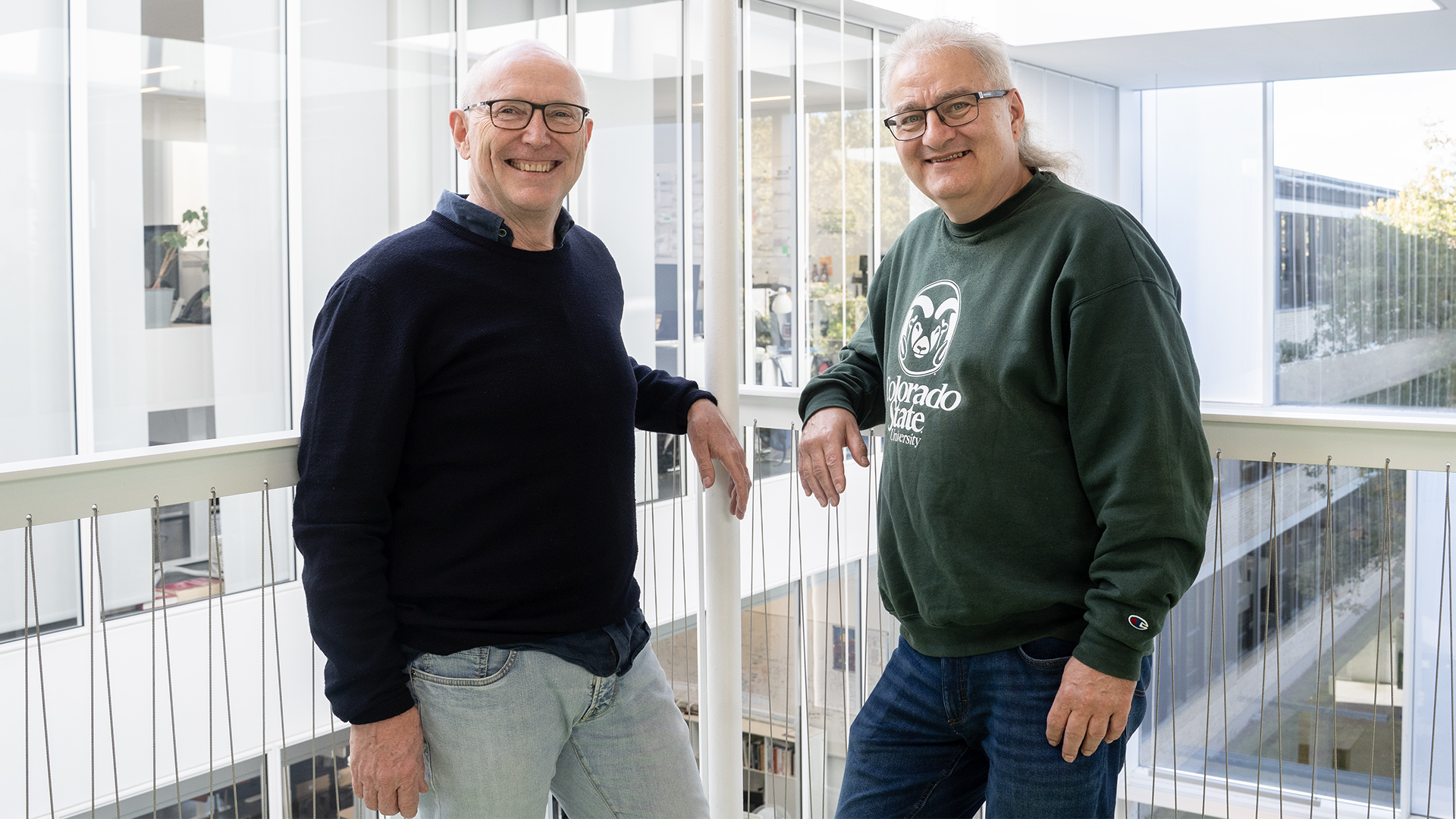
Professor Peter Steen Mikkelsen at DTU Sustain (left) and Associate Professor Anders Stockmarr at DTU Compute. Both are very much looking forward to starting work on the project in the new year. Photo: Hanne Kokkegård

A synergy between statisticians and climate researchers

The new grant will enable close collaboration between statisticians and researchers in climate and environmental science, bringing together advanced mathematical modelling and domain-specific knowledge of climate systems.

Mathematics can reveal patterns that climate specialists may not have anticipated. Conversely, climate science helps ensure that the models reflect real-world processes in meaningful ways.

“We can develop new mathematical tools, but it is through collaboration with domain experts that we can see how they perform in practice,” says Anders Stockmarr.

“At the same time, new models inspired by other research fields can provide new insights into the phenomena that impact climate-resilient water systems” says Peter Steen Mikkelsen.

DTU Compute’s involvement in half of the Villum Synergy grants awarded in 2026 reflects our strong position in data-driven and AI-based research, and the significant research potential that comes from working across research domains.
Jan Madsen Professor, Head of Department at DTU Compute

An example from the previous PhD project concerned the role of proximity to the coast. Researchers initially expected coastal location to be a key factor in explaining extreme rainfall events. However, their analyses showed that this effect for lesser thresholds for extreme rainfall was captured through the model’s representation of local weather dependencies and spatial patterns, and the effect therefore appear to manifest for heavier rainfall events only.

More data provide a clearer view

A key part of the project is to make use of a much broader range of data sources than is common today. Current approaches do not fully exploit the combination of traditional rain gauges, which collect rainfall physically in a measuring container, modern weather-station data, and private sensor networks.

In addition to official rainfall measurements, the researchers will investigate how data from local weather stations and other privately operated monitoring networks can be incorporated into their analyses. These may include rain gauges owned by private citizens, businesses, or farmers. Such data can be used to validate and improve the mathematical models.

“The more reliable observations we are able to include, the better our understanding of how rainfall varies at a local level. This can provide a much more detailed picture of where and how extreme events arise,” says Anders Stockmarr.

Flooding on Lersø Parkallé, Østerbro, Copenhagen, 4 August 2024. Photo: Hanne Kokkegård

Models with applications far beyond Denmark

The researchers already collaborate with DMI on climate data and expect the results to contribute in the longer term to future climate services and climate scenario development.

Their ambitions extend well beyond Denmark.

“We hope that, within three years, we will have models that significantly improve our ability to support future climate adaptation decisions. We also hope to demonstrate that the methodology can be applied beyond Denmark,” says Anders Stockmarr.

In the longer term, the ambition is to scale the approach to larger parts of Northern Europe, where many of the same weather systems affect countries across national borders. This will require models that can be adapted to local conditions.

“Denmark is a relatively flat country with limited variation in elevation and comparatively modest geographical diversity. In countries such as the United Kingdom, for example, the geology, hydrology, and topography are very different, with much greater variation across the landscape. The objective is therefore not simply to transfer a Danish model directly, but to develop a methodology that can be adapted to the specific conditions of each country,” says Peter Steen Mikkelsen.

In this way, the researchers hope not only to contribute to improved climate adaptation in Denmark, but also to establish a scientific foundation that can support efforts to address future climate challenges more broadly.

Facts

The grant of DKK 4,440,117 awarded to the project STEM-NEXT – Spatio-Temporal Extreme Rainfall Modelling for Next-Generation Hazard Assessment will fund, among other things, two postdoctoral researchers, one at each department. The project will begin on 1 January 2027.

The project is one of six DTU Compute projects awarded funding in the latest round of the Villum Synergy programme.

The programme supports projects that combine data science and AI with other fields. Read the press release 

The other five projects are:

  • PSYFIND: Psychological Fingerprints for Cyber-Deception with Typological Attacker Classification & Adaptive Defense. Associate Professor Emmanouil Vasilomanolakis, DTU Compute – and Professor Ingo Zettler, Department of Psychology – University of Copenhagen.
  • Physics-Driven Digital Twins for Two-Phase Cooling in AI Data Centers (SmartCool). Professor Henrik Madsen, DTU Compute and Professor Jesper Hattel, DTU Construct.
  • Writing Representation and Probabilistic Trajectory Estimation: Modelling Students' Writing Development. Associate Professor Michael Riis Andersen, DTU Compute, and Associate Professor Kristine Kabel, The Danish School of Education (DPU) – Aarhus University.
  • A Fleet‑Scale Data-driven Framework for Global Wave Sensing (Fleet-GLOWS). Associate Professor Allan Engsig-Karup, DTU Compute and Associate Professor Ulrik Dam Nielsen, DTU Construct.
  • Data-driven design of tunable chalcogenide thin films for next-generation indoor and tandem photovoltaics. Associate Professor Mikkel Schmidt, DTU Compute and Senior Researcher Stela Canulescu, DTU Electro.

Contact

Anders Stockmarr

Anders Stockmarr Associate Professor Department of Applied Mathematics and Computer Science

Peter Steen Mikkelsen

Peter Steen Mikkelsen Professor Department of Environmental and Resource Engineering

Jan Madsen

Jan Madsen Head of department, Professor Department of Applied Mathematics and Computer Science