Building games and building skills: students completed full production cycle
A classroom at DTU Compute has been transformed into a real game studio as part of Denmark’s unique game development programme, DADIU; a project that blends art, technology, and design. The team was assembled as a cross-disciplinary team to highlight the different processes involved in game design.
Oops, this feature requires cookies
To view the content, you must change your cookie consent to allow functionality and targeting cookies
Click above to watch the trailer for the game Once Upon a Shell
If you walked through Building 324 this autumn, you may have noticed the same thirteen students gathered day after day, deeply focused on their screens. These students had turned a classroom into a fully-fledged game studio as part of DADIU – the National Academy of Digital, Interactive Entertainment – a semester-based programme designed to simulate professional game production.
The team, known as Razzledazzle Studio, is one of six DADIU teams formed through individual applications. Students outlined their learning goals, game ideas, and preferred roles before being assembled as cross-disciplinary teams. While this team worked at DTU Compute, another was based at DTU Skylab.
On a Tuesday in early December, Professor in computer graphics at DTU Compute Andreas Bærentzen visited Razzledazzle Studio to provide feedback on the team’s final project: Once Upon a Shell. After six weeks of development, the game and its trailer were nearly ready for presentation at DADIU’s graduation ceremony, where all six teams showcased their work.
Invaluable learning
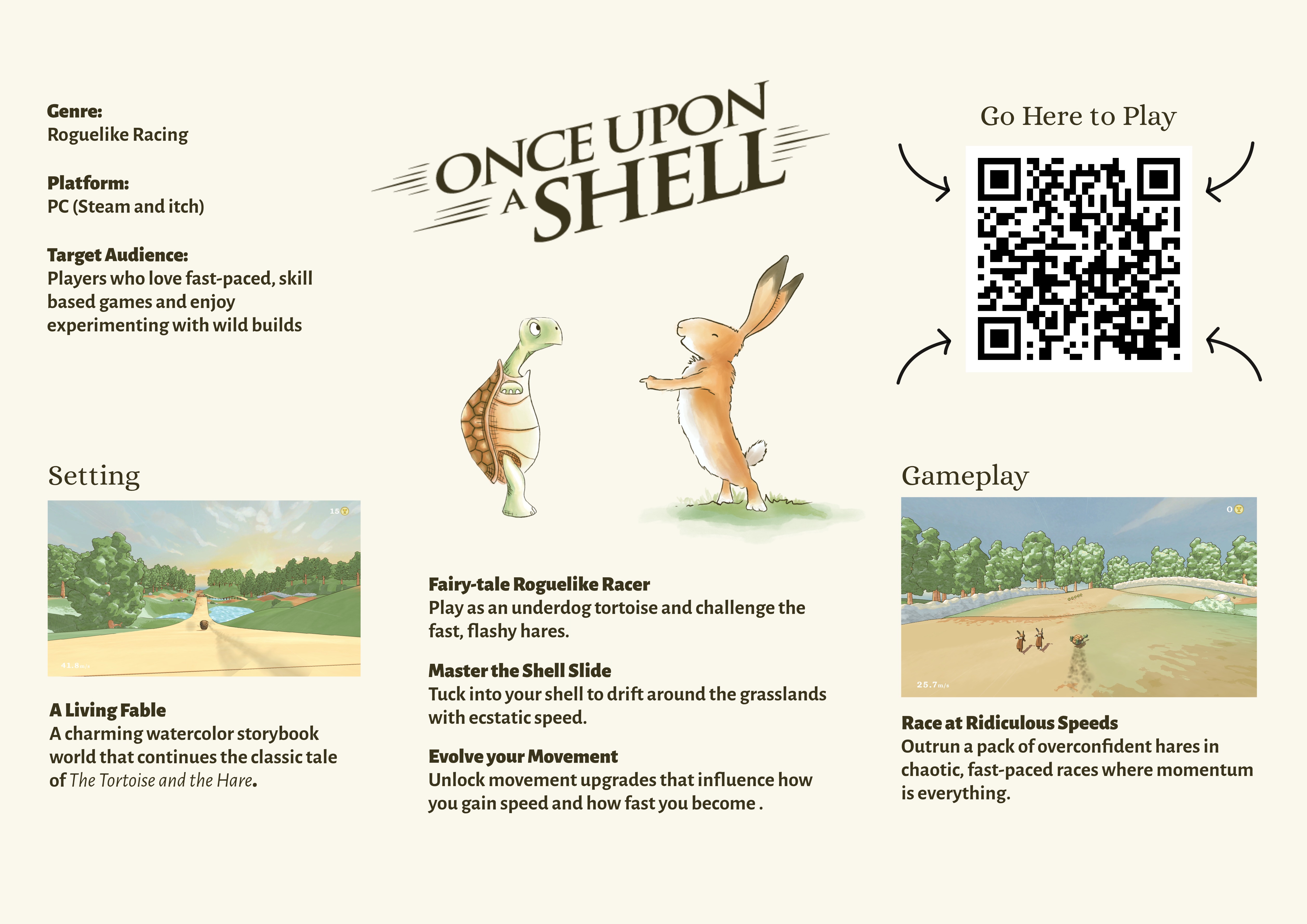
The game’s premise is simple yet charming: help an underdog turtle outsmart and defeat a group of fast, competitive hares. For experienced players, the game takes about five minutes to complete; for most, around fifteen.
Producer of Once Upon a Shell, Viktor Máni Mønster, was very satisfied with the semester:
“It is quite possible that I will seek to work in the games industry afterwards. However, even if I do not, the experience of working in a large cross-disciplinary team is something I have not encountered elsewhere.”
For those pursuing careers in game development, the project serves as an invaluable portfolio piece.
“Producing work of this quality is not something we could achieve in our spare time. Being able to enter the job market and say, ‘this is what we have created’, is invaluable,” he said.
One-Pager for Once Upon a Shell.
A simulation of the cross-disciplinary work
The DADIU programme was founded in 2005 by Gunnar Wille, at that time the head of the Danish Film School’s animation department. In 2011, DADIU became a full-time semester programme.
The thirteen students at DTU Compute come from diverse academic backgrounds, including human-centred AI, computer science, game studies, digital art, and media science. They join forces for one semester, followed by exams within their own institutions.
The game Once Upon a Shell was developed using Unity, a powerful cross-platform game engine.
The work was divided among specialized teams: an art team handled models and animations, a tech team programmed in C#, and a design team crafted the story, mechanics, and pacing. A level designer built the environment, a composer wrote the music, and a producer coordinated the entire process.
A unique opportunity to make something to be proud of
"DADIU is an amazing opportunity for our technical students to work with other students who also want to make games but have completely different skill sets. It is really an innovation programme devoted specifically to computer games. They bring in mentors from the games industry and set up an environment that is very similar to an indie studio," said Andreas Bærentzen and continued:
"DTU has been part of DADIU since the beginning, and I think it has been very worthwhile. DADIU isn’t just a simulation of the cross-disciplinary work of a game studio. It also offers a lot of creative freedom to the students. As such it is a very unique opportunity to make something they will be proud of, and almost all the students that have participated have greatly enjoyed it.”
That is exactly what the Game Director, Vladimír Hořký, emphasized. He has already submitted the game to various events.
“In fact, we are almost obliged to sign up for one that will take place here in Copenhagen. I have already submitted our game to several festivals, in Prague as well. It is extremely valuable to attend a game development industry event and have a finished game to present, as it makes networking much easier and provides something tangible to showcase on the spot.”
DADIU 2025 Team 3 – Razzledazzle Studio
DADIU 2025 - all students
Razzledazzle Studio at DTU Compute. Photo: Hanne Kokkegård
Razzledazzle Studio at DTU Compute. Photo: Hanne Kokkegård
Razzledazzle Studio at DTU Compute. Photo: Hanne Kokkegård
Razzledazzle Studio at DTU Compute. Photo: Hanne Kokkegård
Facts
Links to the DADIU and the Once Upon a Shell universe