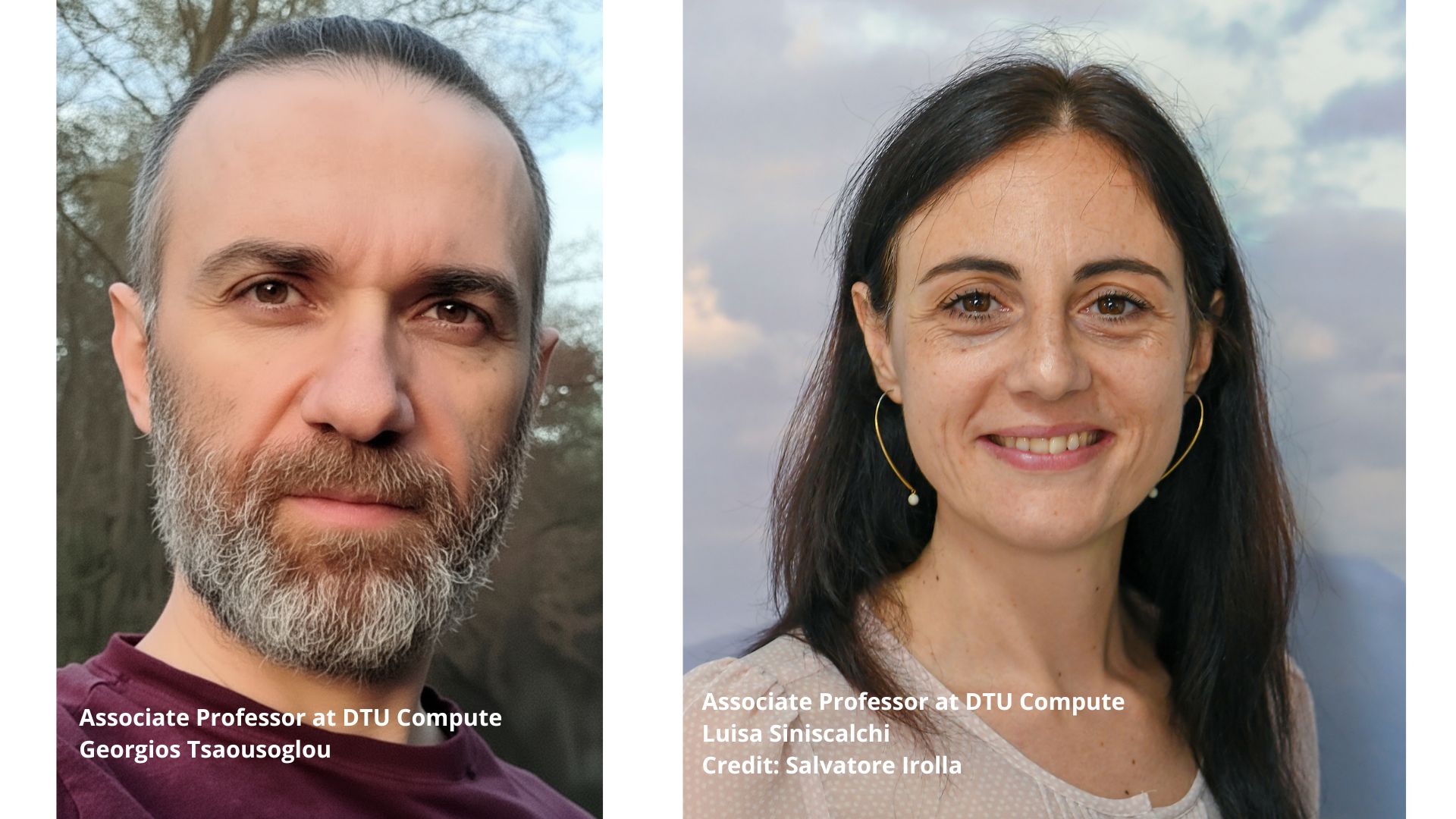
It is a major milestone for any researcher to begin establishing their own research group. Two talented researchers at DTU Compute, Luisa Siniscalchi and Georgios Tsaousoglou, have just received funding from the Villum Young Investigator Programme that will enable them, over the next five years, to each hire two PhD students and a postdoc to support their research.
The Villum Foundation has awarded DKK 126 million to 14 early-career researchers through the Villum Young Investigator Programme, supporting ambitious scientific ideas and helping young talents establish their own research groups for the first time.
Among the other 12 researchers are two more from the Technical University of Denmark: Antonia Herzog from DTU Chemistry and Sinja Rist from DTU Aqua.
Associate Professor Luisa Siniscalchi working at the Cybersecurity Engineering section at DTU Compute
Project: Publicly verifiable zero-knowledge proofs: A practical, powerful leap beyond non-interactive zero-knowledge
Zero-knowledge (ZK) proofs are cryptographic protocols that allow you to prove that a statement is true without revealing any of the secret information behind it. This project investigates how to balance efficiency and security in publicly verifiable zero-knowledge protocols. It aims to overcome today’s trade-off between fast but potentially weaker ZK protocols and very secure yet impractical ones.
The results will support the development of more trustworthy privacy-preserving technologies.
The grant will support two PhD students and one postdoc.
Associate Professor Georgios Tsaousoglou working in the Dynamical Systems section at DTU Compute
Project: MELISANDRE: Market equilibria likelihood and safety assessment in AI-driven energy systems
Power systems serve as the foundation of a nation's economy, and electricity markets ensure demand is met at minimum cost. However, market participants are increasingly using AI agents for bidding strategies. Each AI agent tries to maximize its own profits, possibly in ways we didn't anticipate, and we don't yet understand whether their interactive learning could lead to unforeseen strategies and detrimental system outcomes.
MELISANDRE uses optimization and game theory to investigate how detrimental the market outcome can get, and how we can proactively ensure system safety and efficiency.
The grant enables the recruitment of two PhD students and one postdoc.