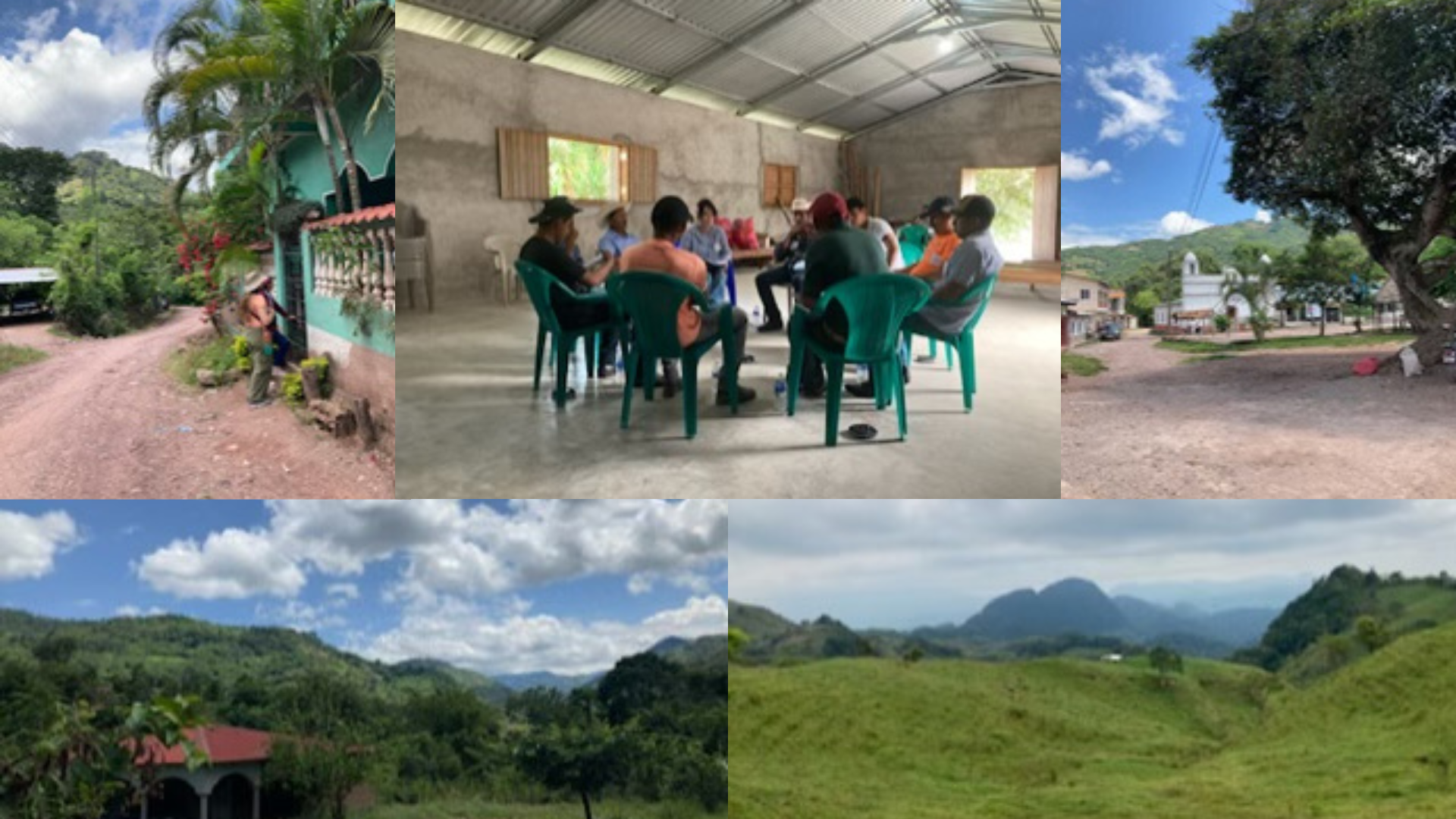
Deep in the western highlands of Honduras lie small villages where paths wind between the mountains, and where news and important messages are still spread by word of mouth. But the way knowledge travels is far from random. A new network model and research from DTU Compute helps to shed further light on this pattern.
Starting in 2016, researchers from the Human Nature Lab at Yale University in the United States travelled to the Central American country to carry out a vast field study with the support of the Honduran Ministry of Health. More than 24,000 people living in 176 villages took part. Each village constituted its own social network of personal relationships (friends, family, and economic and health-advice ties).
Through interviews about these social relationships, the researchers wanted to understand how knowledge, behaviour and needs for support spread in some of the world’s most isolated communities. They found that it is not necessary to know the entire social network to spread important maternal and child health information, and that social contagion could be fostered in these communities in beneficial ways.
Choose the right connections
Using the so‑called friendship paradox – the principle that “your friends have more friends than you do” – the researchers discovered that one can simply select random people and ask them to point to their most central friend. That friend often turns out to be an effective messenger.
This strategy makes health information spread far more quickly than broad campaign communication, because the messages “jump” through the right connections. This saves both time and resources for authorities who would otherwise have to reach the entire population directly.
Several layers of relations between individuals
Researchers from DTU Compute and Yale University have since delved deeper into the field study and developed the new network model to better understand how these networks are structured.
The model is designed to characterise structure of multiplex social networks – networks with several layers of relations between individuals, and where the model takes into account that each person is part of several networks simultaneously. A person may be someone’s friend, but also someone from whom they seek health advice or a financial loan, for instance. The research has just been published as early access in Nature Communications.
“Our developed network model makes it easier to understand how multiplex social networks are organised by characterising the roles of all the individuals within a village. Although it is basic research, such knowledge can potentially have great significance,” says Professor of Machine Learning at DTU Compute, Morten Mørup.
It is former DTU Compute PhD student Nikolaos Nakis who is the first author of the study. Morten Mørup and Professor Sune Lehmann have been his supervisors.
During his PhD, Nikolaos was on exchange with Nicholas A. Christakis at the Human Nature Lab at Yale University, where he was introduced to the extensive field study.
When Nikolaos returned to Denmark, work began on analysing Christakis’ data using ideas from his PhD project. Today, Nikolaos Nakis is a postdoc at the Human Nature Lab, and the work on developing the network model has now been completed.
“What excites me about this model is that it helps uncover the hidden roles people play across different domains of life. Rather than looking at relationships in isolation, it shows how different kinds of ties fit together and how people navigate these trade-offs in everyday life,” says Nikolaos Nakis.
Relations, interaction, and exchange
In the Honduran data, the original research examined several kinds of personal relationships, including three basic types:
- Social relations – who spends free time or talks with whom.
- Health relations – who one seeks advice from.
- Economic relations – who gives or receives support.
The model, named the Multiplex Latent Trade‑off Model (MLT), is inspired by social exchange theory, where various factors give rise to relations, interactions and exchange. It is based on the idea that every person in the villages – every node in the network – is involved in multiple relations at the same time. To understand how people interact the layers must be analysed together, not separately.
In practice, this means that each individual functions both as a sender and a receiver of relations, and that these roles are distributed differently across the layers. This is where the model’s central mechanism comes into play: trade‑offs.
Trade‑offs mean that a person can only “position themselves” in a certain place in relation to the social, health‑related and economic layers. If a person is very active in one layer, the model will show that they are typically less active in the others. In this way, the model reflects the real limitations of human relationships: one cannot be everything to everyone at the same time.
The MLT model therefore places each person in a mathematical space (a so-called simplex), where their role is distributed as a weighted combination of the three layers. This gives researchers a precise picture of whether a person primarily functions as a social relation, a health adviser or an economic support – or a mixture.
Independence, dependence or interdependence
At the same time, the model calculates how relations arise through three types of mechanisms:
- Independence – driven by the individual’s own needs.
- Dependence – when relations are driven by others’ status or resources.
- Interdependence – when relations are mutual and specific between particular individuals.
By estimating how strongly each mechanism influences each layer, the model shows the extent networks are organized by interdependence as opposed to only by the individual’s own needs and status (independence and dependence).
Moreover, the MLT model builds a hierarchy of communities to characterise the interdependence that ranges from large macrostructures to highly detailed microstructures. This makes it possible to see who interacts with whom – from the broad level all the way down to the level of a few individuals.
Whereas the original research primarily focused on identifying the right individuals, the new research seeks to understand the structures and mechanisms of the relations characterising the roles of all the individuals. Using the network model, one can see that social relations are strongly characterised by interdependence, whereas health and economic relations are primarily driven by individual’s own needs and status.
The story continues below Fig 2.