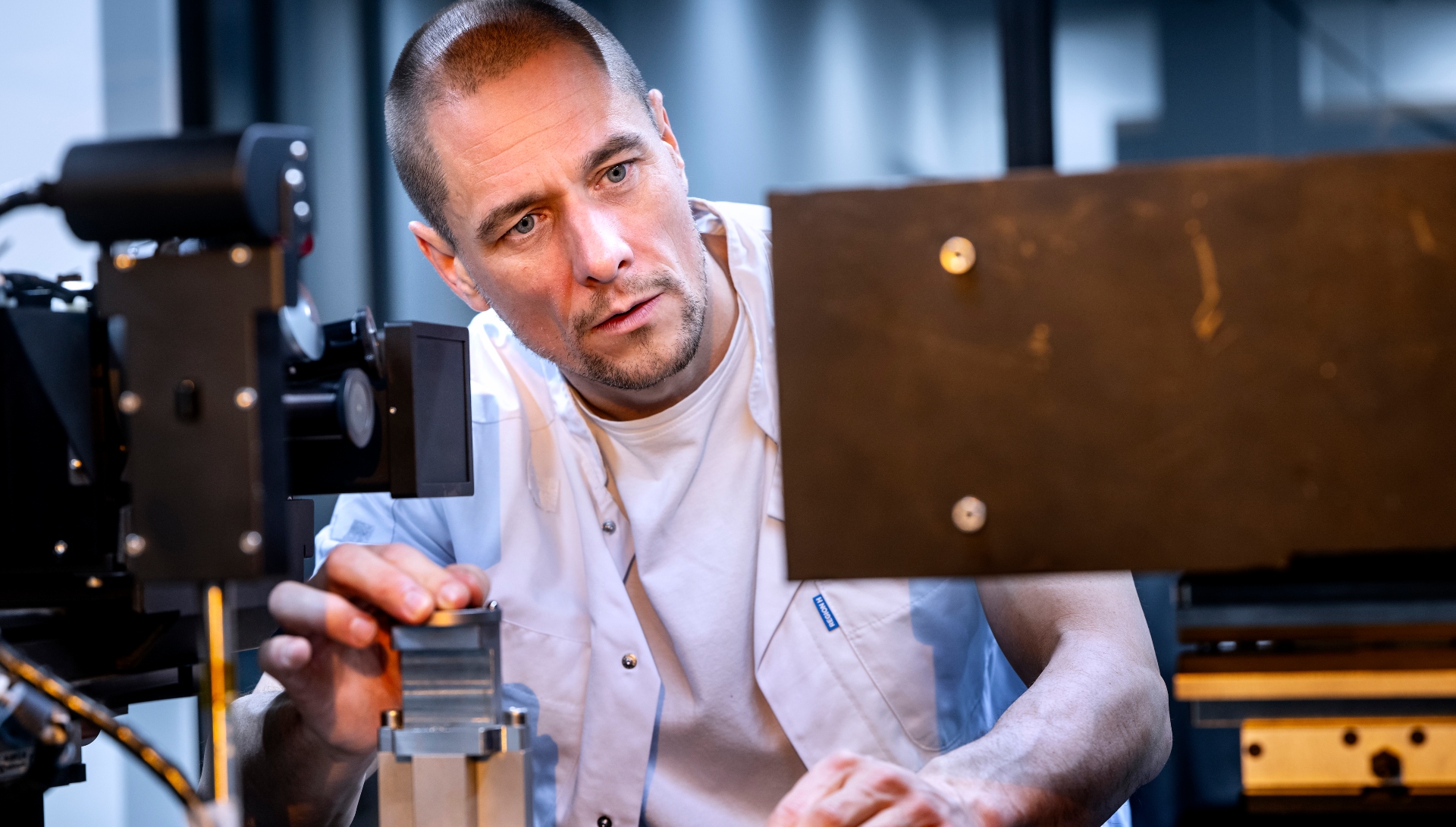
The idea of being examined for cancer in the mucous membranes and throat by a robot immediately causes discomfort for most people. But for ear, nose, and throat surgeon and cancer specialist Tobias Todsen, who is the first surgeon to be appointed as a clinical professor at DTU, it is only natural to focus on the benefits for patients and the quality of care that comes with new technology becoming part of everyday life in hospitals.
“When we follow up after cancer surgery today, we look into the mouth and assess whether there are any changes that could be suspicious in relation to what we expect after treatment. We do this through regular check-ups, for example, every six months,” says Tobias Todsen.
"This workflow can be improved so that patients do not have to wait but can be checked by a robot that scans the throat more often and at a time that suits the patients themselves. In this way, AI models can detect early cell changes that we would otherwise have detected too late. At the same time, it will also save unnecessary check-up times at the hospital, which can then be used for faster treatment and more time for patient care," he says.
Close collaboration with engineers
The appointment of doctors to professorships at DTU began in 2023 as a prelude to the Technical University Hospital (TUH) partnership between DTU and the nine hospitals in the Capital Region (see fact box).
The scheme is a completely new way of connecting technical research environments with clinical practice. The overall goal of the scheme is to promote innovation, entrepreneurship, and the development of new health technology solutions for the benefit of patients.
Tobias Todsen has worked for many years at the intersection of technology and surgery. As a senior physician at Rigshospitalet, he uses advanced imaging, robotic surgery, ultrasound, and gentle methods to remove cancer on a daily basis. The technologies he uses in his clinical practice are often developed in close collaboration with engineers—and it is precisely this link that is now anchored in his new role at DTU.
From operating room to development laboratory
For Tobias Todsen, the clinical professorship is a platform that enables him to act on the needs he experiences as a surgeon in the clinic and use this to initiate the development of new technology.
At Rigshospitalet, he heads the SURGiC research group, where doctors and engineers work together to develop new diagnostic testing and imaging technologies. Among other things, the group is behind a three-dimensional ultrasound scanner for cancer surgery, which has been patented and further developed in the spin-out company 3Sonic. The technology behind it was born out of a specific clinical problem: the need to be able to assess whether a cancerous tumor has been completely removed while the patient is still on the operating table.
Tobias Todsen points out that this type of interdisciplinary collaboration can be accelerated at DTU, where the engineering communities have a natural culture of innovation and entrepreneurship. In the healthcare sector, the culture of innovation is more conservative, he notes.
“In the healthcare sector, there is a culture that is skeptical about doctors making money from anything other than their clinical work. There must be no conflict of interest. But if we don't open up and make it more acceptable for us to develop our technology, then we'll just have to buy it from companies in China or the US,” says Tobias Todsen.
Economics must be considered from the outset
He points out that the Danish healthcare system has great untapped potential for inventing new technology or developing it in collaboration with Danish companies.
"We have a highly educated medical profession. There are many who have PhDs, who also conduct research and come up with ideas.
But ideas must be able to be translated into something that can become a solution for patients," says Tobias Todsen.
He believes that the best framework for developing technology is for ideas to be established as innovation or entrepreneurship projects, where researchers involve patients' needs in the solution from the outset. Furthermore, it is very expensive to get new technology approved for patient treatment, so it is important that researchers consider whether it is possible to make money from it.
"Doctors and engineers need to have the financial aspect in place from the very beginning, so they apply for patents before they publish. Otherwise, they cannot protect their inventions and build a business case that will attract investors to support product development,” says Tobias Todsen.
When engineers and doctors think together
He points out that doctors often think alike due to standardized training and a professional hierarchy in hospitals. However, when they work with engineers in the clinic or doctors visit DTU, their professional dogmas are challenged. It is in this encounter that real innovations arise.
Conversely, he emphasizes that technical research projects can fail if they are not based on an understanding of the clinical workflows and patient needs they are intended to support. That is why the two disciplines need each other.
As a clinical professor, Todsen wants to develop teaching where medical students and engineering students work together on technological solutions to clinical problems. He sees a great need to open DTU as a platform for medical students for thesis projects, courses, and research programs.
A professorship with a mission
Although Todsen now has an office at DTU, he continues to spend half his time treating patients as a senior physician. This is where ideas arise and where he sees what can be improved. His goal is to be a link: to bring clinical needs into technical research environments—and bring new technologies back to patients.
In his new role as clinical professor, Tobias Todsen will be a key figure in the development of future technological healthcare solutions and in ensuring that these solutions are based on real clinical challenges. He believes that the most promising technologies are to be found in AI models that collate a wide range of patient data, but robotics and the development of home diagnostic tests also have great potential and will reduce waiting times and transport for patients, as well as significantly improving the quality of healthcare.