About the chip design course
Facts and links
- Teaching materials (open source):
https://github.com/os-chip-design/chip-design-intro - Student project GitHub:
https://github.com/os-chip-design/dtu-soc-2026
From virtual testing to physical reality
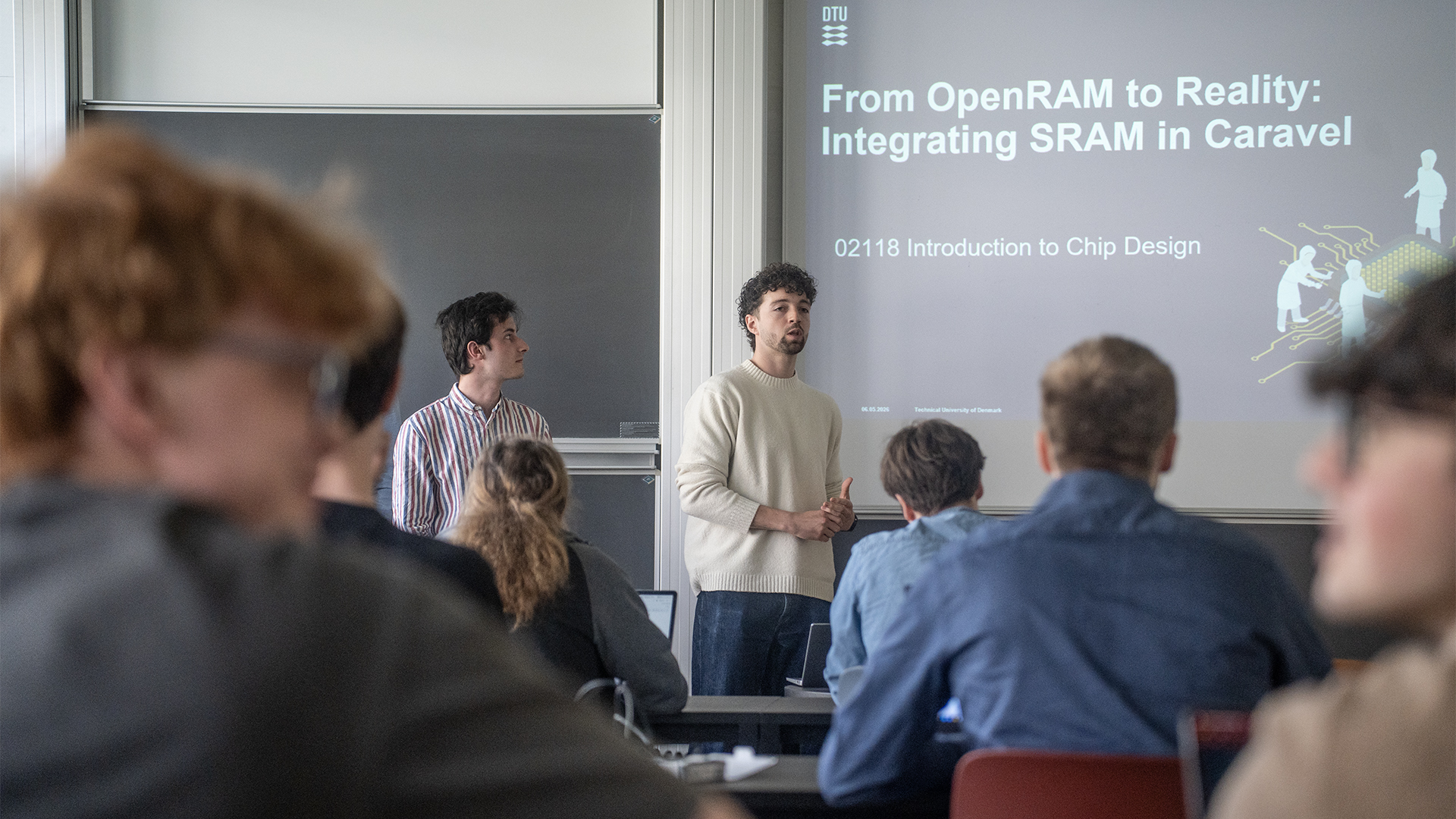
For the first time as part of a regular course, a team of DTU students is sending a self-designed microchip for physical production at a US-based manufacturing facility.

The world had the chip crisis during COVID-19, where we suddenly ran out of microchips, because they are produced in Asia, which delayed the production of almost every electrical equipment.
That was an eye-opener for the European Union and illustrated clearly that we needed to start our own chip production. The answer is the EU Chips Act for European independence in chip design and production.
“At the same time the Danish chip design industry lacks well-educated chip design engineers. Our new course on chip design is meant to strengthen our education in that area,” says Martin Schoeberl.
This year’s microchip is expected to return to DTU in approximately six to ten months.
The manufacturing has been made possible with help from the Edu4Chip project (USD 15,000) funded by the European Union. Edu4Chip is an education project that brings together several European universities to strengthen advanced chip design education.
The course is expected to run again next year.
One of the challenges ahead will be securing additional funding – potentially through industry partnerships – to ensure that more students can experience the entire journey from initial design to a physically manufactured chip.

About the chip design course
Martin Schoeberl Professor masca@dtu.dk